
“So, regarding miracles, I will confess to you that I have not seen a miracle here of a blind man seeing, a paralyzed man walking, a sick man being healed before my eyes. But I have seen thousands of souls who come tired, disappointed, even to the point of abandoning life violently. And then I have seen them depart from Virgin Mary, light-hearted, smiling, internally rested, and deciding that they must put an end to it and start a new life.”
I think that the majority of us would easily subscribe to a similar statement. Even for the part that refers to the patient’s internal ‘conversion’, the healing of his ‘soul’, we would not raise a strong objection. I noted, among other things, in “The News” in November 2022 that:
“As is well known, placebo is a virtual medicine. Unlike authentic medicines, in the case of a placebo it does not matter in the slightest what its ingredients are, as long as – of course – they are not harmful ingredients: in a placebo, for example, you can put saccharin, but you cannot put chlorine. The essential thing is that these are ingredients that theoretically will have a ‘neutral’ effect on the patient’s body, neither will they ‘improve’ it, nor will they “worsen it”. We always say ‘theoretically’ – and we have a serious reason for saying so. This is precisely why placebos are widely used in pharmaceutical research and act as “testing grounds” for authentic medicines. You see, sometimes, placebos deny their expected ‘neutral’ effect and bring positive results to the patient’s health. This happens when the causes of the disease are psychogenic – a psychological ‘blockage’, in other words, of the nervous system – and they are certainly still reversible. A placebo, for example, can work ‘miracles’ in cases of hysteria (here lies the reason why hysterics of all kinds are always preferred as ‘attractions’ by exorcists of all kinds), but it can do nothing in the case of a paraplegic, an incurably blind person, or a deceased person. Like bullshiting, placebo has its limits.”
It goes without saying that the healing role of a placebo can be taken on by any object and not necessarily an icon: a talisman, a hare’s foot, a few hairs from your beloved other’s lush hair, the rickety teddy bear in your toy cupboard, ‘Loupasakis’ Holy Cross [translator’s note: another Greek religious scam] , the lost children’s sled that Citizen Kane christened ‘Rosebud’ in Orson Welles’ famous film… So it doesn’t matter so much what someone says about things that we take for granted, as who says them. The initial statement, stripped of its context, adopted by every skeptic who uses common sense every day, acquires a different weight and displacement when we weld it to its conclusion: “So, inner miracles, within the souls of people, I have to tell you thousands of them from the 45 years of my ministry, in this Metropolis and on the holy step of the Evangelistria.”
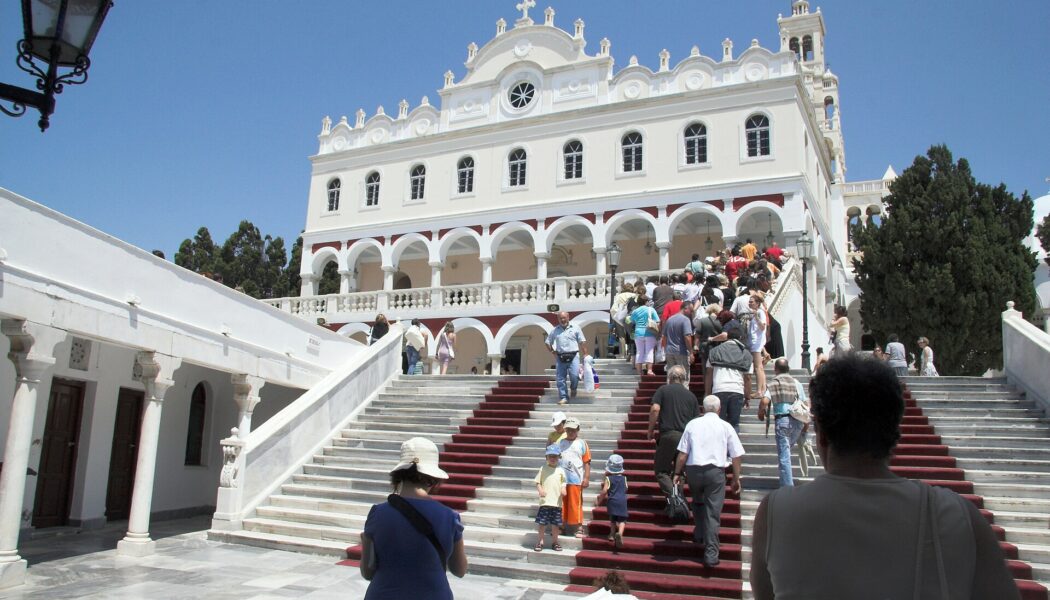
Oh, yes. These words were not uttered by a usual “enemy of the Orthodoxy”, predictable and manageable by the leaders of the lambs and goats, but by the Metropolitan of Syros and Tinos, Dorotheos II himself. He told journalist Viki Vamiedaki for the news website “NEWS 24/7”, in the context of a revealing report that was first published in March 2022. If the classic definition remains in force, according to which news is not “dog bites man” but “man bites dog”, here we have its most typical case.
I do not want to question Dorotheos’ courage, nor the importance of the legacy he leaves with this statement of his, but I would appreciate it more if it were accompanied by acts of similar or even higher symbolism. If, for example, on the day of August 15, in front of the temple of Virgin Mary of Tinos, he would abandon the official platform and the peacocks posing smugly next to him, descend downside to the crowd of the unfortunate, approach the relatives of the kneeling ones and whisper to them tearfully: “Please; take your man from here; he is not going to get better; I have never seen anyone get better.” Yes, I know, something like that will not happen, not only during my own lifetime or the lifetime of my children, it will not happen in all eternity, because Dorotheos and every Dorotheos, as intelligent people, are fully aware that almost none of the tortured come to Tinos for their inner ‘conversion’. They don’t give a shit for their inner ‘conversion’, they come to cure the incurable disease of their body, they come for the ‘miracle’ that cannot be done and they, the Dorotheos kind, know that it cannot be done and yet they continue to behave as if they do not know, as if they do not rule out the possibility that was ruled out long ago.
Why do they continue? Dorotheos will not give us the answer. The journalist Giorgos Leventis has already given it to us since September 2015 with a shocking report that was published at the time in the “Parapolitika” newspaper, was widely reproduced, caused a stir… -and then? Then, nothing. An “amicable settlement” between Church and State placed the final tombstone on what could have turned out to be a major political, economic and religious scandal.
“To the Grace of Virgin Mary,” writes Leventis, “especially every August 15th, thousands of believers flock from every corner of the country to Tinos, where they leave even their wedding rings, their baptismal crosses, precious jewelry and family heirlooms with great emotional value. Human suffering unfolds on the steps of the church of ‘Megalochari’, where people kneel and leave their most precious things to the icon of the Virgin Mary, expecting Her blessing, to be healed and protected from serious health problems. However, the votive offerings do not stay in the temple, as those who leave them there believe, but when the doors close, a perfectly organized marathon begins to melt them and turn them into gold plates. ‘Parapolitika’ today brings to light the documents of the ‘golden’ business with the mythically valuable votive offerings of Tinos, which was revealed due to a suspicious suitcase found at the Athens airport. Specifically, a few days ago, on the 8th of the month, airport customs officers blocked a suitcase containing seven gold bars. The passenger with the initials K.M., was traveling from Turkey and told the surprised officers that the gold came from melted offerings in Megalochari. The precious luggage was detained by customs officers, as certain documents were missing that the person inspected assured that he would provide. The “passenger’s baggage receipt” revealed by ‘Parapolitika’ mentions the full details of the precious metals trader from Crete, as well as the fact that “a suitcase containing seven gold bars, weighing 7 kilos and 82 grams” was detained at the airport. The agreement between the Panhellenic Holy Foundation of Evangelistria of Tinos (PHFET) and the merchant, signed two days before the 15th of August and the influx of people to Tinos, on 13/8/2015, describes in detail the terms of the ‘gold’ deal.
“The above-defined quantity of twenty-one (21) kilograms of pure gold will be delivered by the second contracting party in twenty-one (21) bars, weighing one (1) kilogram each, each of which will be stamped during casting with the numbering and certification of the internationally recognized NADIR foundry, a member of the London Bullion Market, and will necessarily be accompanied by certification documents that will attest to its authenticity.”
An entire business is set up for the exchange of gold, with strict schedules.
“The delivery of the alloy bars and the receipt of the pure gold bars will take place at the offices of the PHFET in three phases, during the period from the signing of this contract until August 25, on days and times to be determined for security reasons between the two parties, as follows: A) The second party will receive one (in sequence) alloy bar at a time, having the obligation within 72 hours to return by delivering seven (7) pure gold bars of one (1) kilo each, certified in accordance with article 1 of this, at which time he will receive the next alloy bar in sequence”.
In fact, for the exchange, the merchant is required to pay a deposit of 200,000 euros, which is kept in a safe in case something goes wrong.
“The above procedure will be carried out under the same conditions for the three alloy bars, that is, until the first contracting party delivers all three alloy bars to the second contracting party, and the latter has delivered to the first contracting party the total quantity of (21) kilograms of pure and certified gold as above. B) The second contracting party, arriving to receive the first bar in order, will deposit with the PHFAT, as a guarantee for the proper execution of this contract, the amount of two hundred thousand (200,000) euros in cash, which will be kept in a safe under the responsibility of the PHFET and will be delivered to the second contracting party after the smooth completion of all three stages of the procedure, based on which he must have delivered to the PHFET the total quantity of (21) kilograms of pure and certified gold. The above guarantee of two hundred (200,000) euros, in the event of a breach of the terms of execution of this contract concerning the procedure, conditions and terms of delivery of alloy bars and receipt of pure gold bars, the entire amount will be forfeited in favor of the Panhellenic Holy Foundation of Evangelistria of Tinos, and the execution of the contract will be terminated ipso jure”.
The gold is eventually purchased by the Bank of Greece and the Tinos Foundation receives cash. However, until this is done, the authenticity of the bars may be questioned.
“The receipt of the bars by the first contracting party does not imply the definitive acceptance of the authenticity of the bars and the acceptance of their agreed content in pure gold, as he is entitled to claim any appropriate compensation from the second contracting party, in the event that at a later time, up to the purchase of the bars by the Bank of Greece, a difference is found from what was agreed and certified regarding the weight of twenty-one (21) kilograms of pure gold that the bars to be delivered by the second contracting party must contain”.
The votive offerings to the Virgin Mary, as it appears, are melted and initially become alloy bars, which are then delivered to traders, who transport them to foundries abroad, in this case in Turkey, so that they can be converted into pure gold and returned to Tinos. ‘Parapolitika’ also reveals the agreement that the legal representative of the Panhellenic Holy Foundation of Evangelistria of Tinos has concluded with a specific precious metals trader for the processing of “gold alloy bars, which come from melting donated valuables unsuitable for sacred use”. To be precise, the subject of the agreement is the “exchange of gold alloy bars from melted valuables with bars of pure gold of internationally recognized certification”. In other words, the trader receives the alloy bars and delivers high-quality gold. “The second contracting party will deliver pure gold of internationally recognized certification, of an acceptable form, for purchase from the Bank of Greece, with a total weight of twenty-one (21) kilograms, and will receive the above three (3) gold alloy bars owned by the first contracting party and for which he has carried out an analysis of the pure gold content from samples he received, based on which he submitted his offer. According to the above analysis carried out by the second party, the three alloy bars have an average pure gold content of 510/1,000, a content also acceptable to the first party based on two previous analyses at its disposal”.
The agreement also provides for a share for the trader:
“The total weight of the samples from the three bars received by the second party, amounting to twenty (20) grams, will not be refunded, since it is part of the total weight of the three alloy bars that it is entitled to receive, once it delivers the above agreed pure gold”.
The agreement between the trader and the PHFET states that the first party is obliged to comply with the law at the level of supporting documents:
“The second party, both for the transport and delivery of the pure gold bars and for the receipt and transport of the gold alloy bars, must issue the legal documents as appropriate. The PHFET is the legal owner of the, according to the above, gold alloy bars, which come from melting donated valuables unsuitable for sacred use, for which the necessary receipt and accounting bills have been issued in the official books of the Accounting Office”.
All competent authorities were informed about the location of the suitcase with the seven gold plates at the Athens airport, as the merchant did not have all the necessary documents with him, while questions are also raised by the fact that the precious cargo arrived in Greece hidden in a suitcase.”
It is not by chance that the cassock-bearers themselves call the Virgin Mary of Tinos a “gold-bearing hen”. And to think that this incredible ‘business’, as in the case of the “non-existent” Saint Ephraim and many other similar cases, began in 1822 from the visions of a nun, Pelagia, – known in the world as Loukia Negrepontis -, which led – as suggested by the Theotokos (Virgin Mary) herself, of course – to the discovery of her icon a year later. It should be noted that the Theotokos did not suffer from any particular anxiety about whether the Greek Revolution, – which had broken out just a year before – would succeed, but she was extremely irritated by the delays in the excavations for the discovery, so she even sent a plague to the island, so that the people of Tinos would comply and speed up the digging. And so it happened. The icon was found in 1823, the plague subsided, the church was built and the Panhellenic Holy Foundation of Evangelistria of Tinos, which was established as early as 1825, records a turnover every year that Lehman Brothers at its peak would envy. We are talking about a monstrous “collection mechanism”, according to the famous definition of Nikos Evangelatos, when he referred to a later scandal (that of the Cypriot monastery of Saint Avvakum with the hidden cans for the icons that ‘weep’ and “gush forth myrrh”).
Adaptation to English of an excerpt from Petros Tatsopoulos book “The Devil’s Child” (Metaihmio, 2024).
Petros Tatsopoulos is a writer and former Member of the Greek Parliament.
*featured image from Wikimedia Commons.


