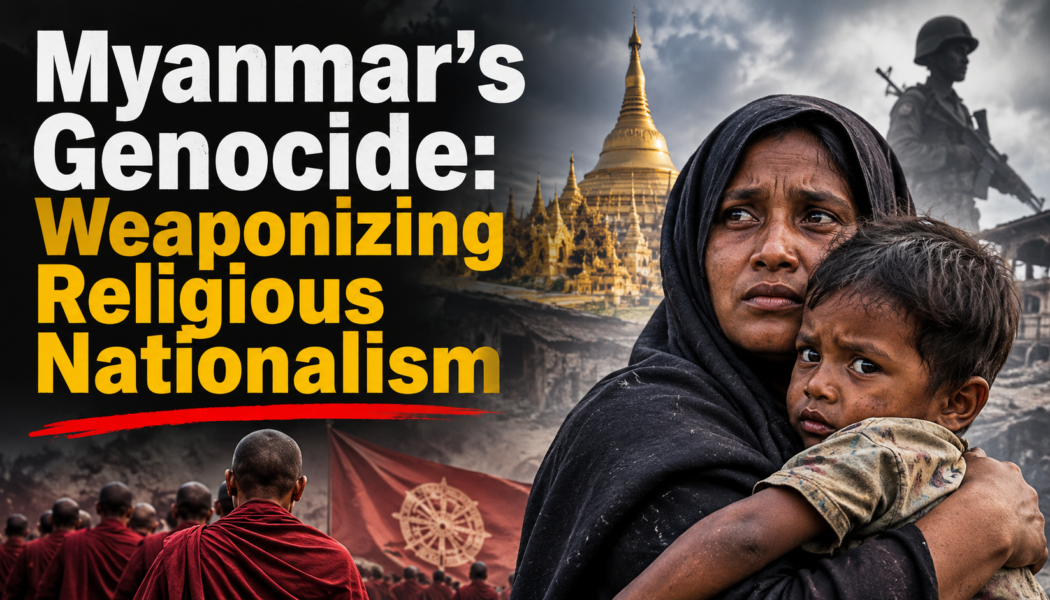
On 19 November 2026, the International Court of Justice (ICJ) delivered a historic judgment: Myanmar was responsible for genocide against the Rohingya, the country’s predominantly Muslim ethnic minority.
The ruling concerns the military’s 2017 clearance operations, during which thousands were killed, women and girls were subjected to widespread sexual violence, villages were burned and more than 700,000 Rohingya driven across the border into Bangladesh. The Court found that these acts were committed with the specific intent to destroy a substantial part of the Rohingya population.
It is a landmark moment for international justice. But the genocide did not happen in isolation. Behind the military’s violence was a longer campaign of religious and ethnic exclusion, fueled in part by Buddhist nationalism.
When Buddhism becomes nationalism
For decades, Myanmar’s Rohingya population has been denied basic rights, including citizenship. The 1982 Citizenship Law effectively rendered most Rohingya stateless, while restrictions on movement, education, marriage and employment reinforced their exclusion.
Their Muslim identity made them particularly vulnerable in a country where Buddhist identity is closely associated with national belonging.
Buddhist nationalist organizations, notably the 969 Movement and the Association for the Protection of Race and Religion (MaBaTha), promoted the idea that Islam threatened Myanmar’s Buddhist character. Their campaigns encouraged boycotts of Muslim businesses, restrictions on interfaith marriage and hostility towards Muslim communities.
Among their most prominent figures was the monk Ashin Wirathu, whose inflammatory anti-Muslim rhetoric earned him international notoriety.
Even more disturbing was the conduct of Sitagu Sayadaw, one of Myanmar’s most influential Buddhist monks. In a 2017 sermon to military personnel, he invoked an ancient Buddhist story to suggest that killing non-Buddhists during wartime did not carry the same moral consequences as killing fellow Buddhists.
This was not an obscure religious extremist addressing a handful of followers. It was a prominent religious authority speaking to the armed forces while their campaign against the Rohingya was underway.
The UN’s Independent International Fact-Finding Mission on Myanmar identified prominent Buddhist monks, including Wirathu and Sitagu, as active promoters of anti-Muslim hate campaigns.
Religion and military power
The relationship was mutually beneficial. The military presented itself as the defender of Buddhism and national identity; Buddhist nationalists provided religious legitimacy for its political agenda.
The result was an environment in which an entire population could be portrayed as foreign, dangerous and undeserving of equal rights.
The 2021 military coup further exposed the relationship. Some prominent Buddhist nationalists openly supported the junta, while others avoided condemning its violence. Wirathu, whose sedition charges had been dropped, was released from prison.
But Myanmar’s Buddhist community is not monolithic. Buddhist monks and ordinary citizens have also opposed military rule, supported democracy and helped those persecuted by the regime. The issue is not Buddhism itself, but the political exploitation of religious identity.
The lesson
The ICJ judgment establishes the responsibility of the Myanmar state under international law. It does not establish the individual criminal responsibility of individual monks, nor does it amount to a prosecution of religious organizations. Nevertheless, the role of religious nationalism in creating the conditions for persecution deserves serious scrutiny.
The Court’s ruling is binding, but enforcement remains a challenge. Myanmar must investigate and prosecute those responsible, prevent further violations and provide reparations to the Rohingya. Whether the authorities will comply is another question.
There is a broader lesson here for societies everywhere.
Religious freedom does not require religious institutions to enjoy political privilege, nor does it justify governments enforcing a particular religious identity as a condition of national belonging. When religious authority becomes intertwined with state power, minorities can quickly find themselves treated as outsiders, their rights subordinated to the supposed interests of the majority.
No religion should be above human rights, and no government should be permitted to turn religious identity into a measure of human worth.
Myanmar’s tragedy is a reminder of what can happen when religious nationalism is weaponized by those who hold political and military power.