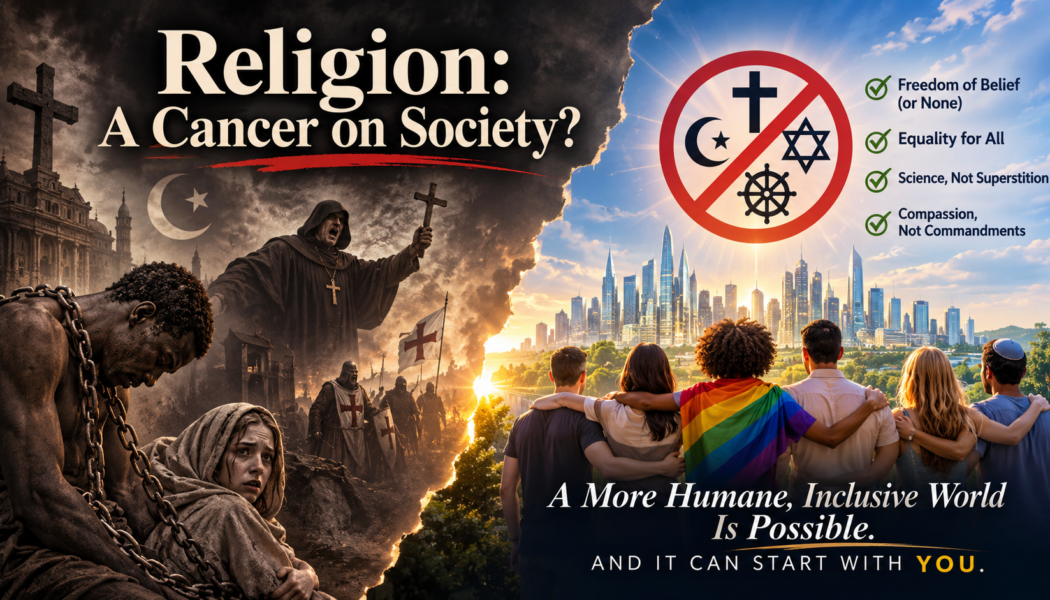
Whether we like it or not, nearly every society at one point or another has been molded by religion, the extent of which varies by nation. Historically, while religion has united communities and fostered social cohesion, it has often led to the degradation, humiliation, and destruction of human beings. Examples include, but are not limited to, conflicts such as the Thirty Years’ War and the Crusades, as well as conquest and forced conversion. Thus, at some point, humankind must evaluate whether ideas—religious or otherwise—are a net good for society and whether they warrant continued validity and public support .
Religious doctrine has often been used to demonize out-groups and justify atrocities, such as institutionalized chattel slavery. Regardless of how uncomfortable this history may be, the two largest religions in the world, Christianity and Islam, both had affiliated empires and nations that perpetrated horrendous acts of enslavement against those they deemed “inferior,” using scripture to rationalize those actions. Here are just a few verses from these two traditions that were historically cited to justify slavery: Genesis 9:25-27; Leviticus 25:44-46; Exodus 21:20-21; Ephesians 6:5-9; Colossians 3:22-4:1; 1 Peter 2:18; and Qur’an 2:178, 4:24, 16:71, 23:5-6, 33:50, 70:29-30, among others.
In my view, religion’s origins cannot be reduced to a single explanation. Humans have long sought meaning, explanations for the world around them, and ways to cope with mortality. Religious belief may also have developed from evolved tendencies to recognize agency, form social bonds, and regulate behavior within groups. As societies became more complex, religious institutions could reinforce social hierarchies and provide a way to legitimize the authority of certain individuals.
Often, following thought-provoking statements—some of which I have included here—I get a reply: “How does it affect you what religion I practice?” It affects me when religious beliefs shape laws, public policy, and the choices people make at the ballot box, as they often do. Countries like Norway, New Zealand, Sweden, Denmark, Finland, Switzerland, Germany, Japan, Canada, and the United States are governed by democratic systems in which citizens have at least some say in government. According to Pew Research Center’s 2020 global baseline estimates, approximately 66.7% of people across these ten countries identify with a religion on average.
Historically and currently, religion is used to justify forms of oppression such as misogyny, homophobia, transphobia, racism, colonialism, slavery, classism, xenophobia, ableism, caste systems, forced assimilation, political authoritarianism, and the suppression of scientific inquiry and free speech. Religion has been, and continues to be, an irrefutable catalyst for many types of cruelty against fellow humans, and many religious people justify actions like these through a religious lens. Because religious beliefs can influence voting and public policy, they often affect my rights and the lives of other marginalized people. When those beliefs are used to justify decisions that affect people like me because of whom we love, they are no longer merely a private matter. Therefore, I conclude that religion is a cancer on society.
Imagine, just for a second, a world without religion: a world where humanity is centuries ahead in science, where religious prejudice does not exist, and where people care for one another not because they are commanded to, but simply because they genuinely care about those around them. Imagine a world where someday I can marry the person I love, no matter what sex they are, and have it recognized globally and at the very least, where I wouldn’t be killed for holding their hand on vacation. Imagine a world where, according to UNICEF, roughly 12 million girls aren’t being married before age 18 each year, as they are now. Imagine a world where people don’t think their morality should dictate what other people do with their bodies.
This world is possible. This world is plausible. And this world can start with you.